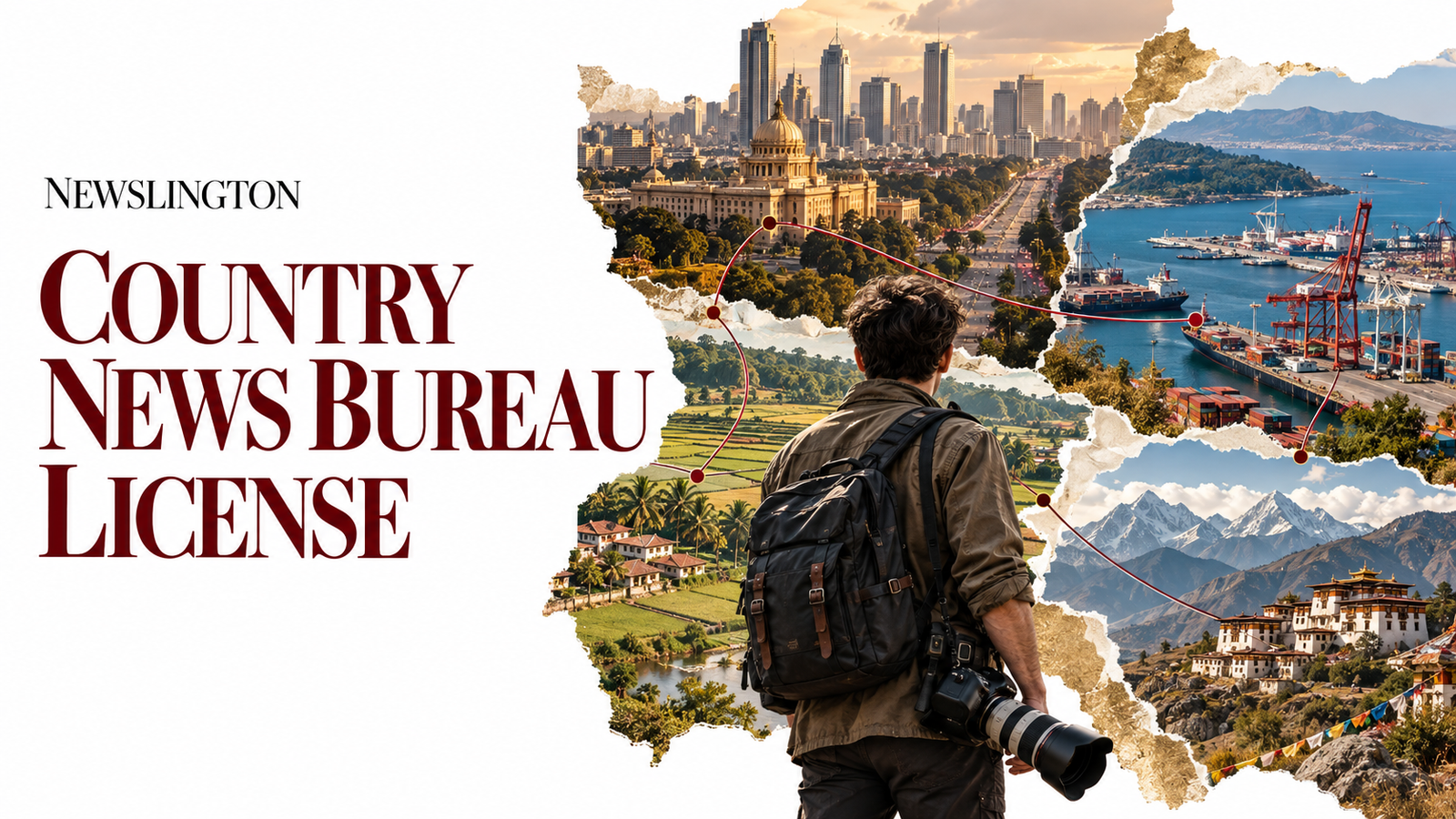
A country cannot be understood through headlines from its capital alone. Its industries operate across regions. Its universities, hospitals, and cultural institutions produce developments far from the centers of government. National decisions reach people differently depending on where they live and work.
A country news bureau exists to connect those developments. It gives a news agency an organized presence within a national territory: people who can find stories, check information, follow events across regions, and explain their significance to readers at home and abroad.
For someone prepared to build a media enterprise, a country news bureau license may provide the right to establish that presence for a particular agency. The license defines the territory and the operating relationship. The licensee builds the team, reporting capacity, audience, and commercial operation that give the bureau its value.
Newslington™ develops opportunities across multiple news agencies and networks. Each agency has its own identity and publishing structure and may establish city and country bureaus. A country bureau operates within one specified agency’s network under the terms of its agreement.
The opportunity is national in scope. Success depends on how well the bureau serves the country it covers.
What Is a Country News Bureau License?
A country news bureau license is an agreement granting specified rights to establish and operate a national bureau for a particular news agency. It should state which country is covered, how the agency’s name may be used, how reporting is published, what commercial activities are permitted, and what the licensee is required to provide.
The license is a defined contractual opportunity. It should not be assumed to transfer ownership of the entire news agency or unrestricted rights over news activity in a country. If territorial exclusivity is offered, the agreement needs to explain its exact scope and duration.
That precision matters because two country bureaus could have very different missions. One might represent an agency covering general news. Another might represent a specialist agency focused on business, science, healthcare, culture, or another subject. Their editorial work, staffing needs, audiences, and potential commercial products would differ.
A prospective licensee should therefore begin with the specific agency and offer. The country name establishes the geographic scope; the agreement establishes what the operator is entitled and expected to build there.
Why a Country Bureau Matters
Many stories that appear national begin as local developments. A change in farming practices starts in one region. An important medical finding emerges from one hospital. A factory decision affects one city before its consequences reach a national industry.
A country bureau can recognize the connection between these events. It can report from the place where a story begins, examine its wider implications, and return to see what happened after the first announcement.
It can also test national claims against regional experience. A policy may be described as successful from a central office while people implementing it encounter different conditions elsewhere. A company may announce expansion across a country while its operations remain concentrated in a few locations. Reporting from several places helps readers understand what a national statement means in practice.
The bureau’s work can serve people within the country and readers beyond it. Businesses may need to follow industries and policy. Researchers may be interested in new work. Communities living abroad may want informed coverage of home. International readers may need context that a brief headline cannot provide.
A national presence becomes useful when it combines reach with local understanding.
How Newslington’s Model Works
Newslington develops and offers news agencies, networks, bureaus, and related media opportunities. The agencies within its model have their own identities and publishing structures. Each can develop a network of city and country bureaus suited to its purpose.
A country bureau license therefore belongs to one particular agency’s network. Its reporting should reflect that agency’s subject and audience. Its publishing process, editorial standards, brand use, and commercial rights should be defined through the applicable arrangements.
Newslington is the parent platform for developing these opportunities. It is not a single geographic publishing system through which every agency’s coverage must flow. A prospective operator needs to understand how the specific agency publishes and how its country bureau participates in that structure.
An agency covering trade, for example, may need reporters who understand ports, production, regulation, and cross-border commerce. An agency focused on education may need a different network of sources and contributors. The right license brings together an agency’s mission, a country with relevant stories, and an operator capable of developing the coverage.
National Scope Requires a Real Plan
A country bureau has a broad territory. That breadth creates opportunity, but it also makes vague promises easy to make and difficult to fulfill.
A new operator may be tempted to announce coverage of every city, institution, and subject from the first day. A small team cannot report an entire country in depth at once. It needs to choose priorities, establish reliable contacts, and expand as its capacity grows.
A workable opening plan identifies the subjects the bureau will follow and the locations needed to cover them. A specialist bureau may begin with several industry centers. A general news bureau might establish reporting in the capital while developing contributors in other regions.
The plan must also account for language, travel, verification, editing, and distribution. Information received from a distant location still needs to be checked. A contributor’s local knowledge needs editorial support. A national headline requires enough context to represent the underlying reporting accurately.
The license gives the operator a national mandate as defined in the agreement. The operating plan determines how that mandate can be carried out responsibly.
Reporting Beyond the Capital
A capital is often an essential reporting base. Governments, regulators, national associations, and major institutions may make decisions there. Their announcements can affect the entire country.
But covering decisions is only part of covering their consequences. Industries may be centered in other cities. Research may emerge from regional universities. Agriculture, tourism, manufacturing, and culture may have important centers far from the capital.
A country bureau needs ways to hear from these places. It might work with regional reporters, knowledgeable contributors, or subject specialists. It might plan regular visits to locations central to its coverage. It should establish channels through which people can bring it information from outside its initial network.
The purpose is not to pretend that every region receives equal coverage immediately. It is to avoid treating one city’s experience as a complete account of the country.
A bureau that knows the limits of its reach can make better decisions about where to report next.
Choosing the Right Country and Agency
A prospective licensee may first consider a country they know well. Knowledge of its institutions, languages, industries, and public concerns can be a strong advantage. It can help the operator identify early coverage priorities and recruit people who understand the territory.
They should also ask whether the country fits the agency. What kinds of stories does the agency publish? Does the country produce important developments in that field? Who would read the coverage, and why would they return?
Existing media coverage deserves close study. Which stories are already reported well? Which subjects receive little sustained attention? Are important regions visible only during crises? Where could this agency’s country bureau make a distinct contribution?
Resources must be considered honestly. A geographically large or linguistically diverse country may require a broader contributor network. A technical subject may require specialist editors. A territory with high travel costs may call for a different opening plan from one where reporting locations are easier to reach.
The best choice is one the operator can explain in practical terms: why this agency, why this country, who the bureau will serve, and how its first year of reporting will be delivered.
What the License Agreement Should Cover
A prospective operator should be able to read the agreement and understand the business they are entering.
The agreement should identify the agency and country, define the rights granted, and specify how the agency’s name and publishing structure may be used. It should state what editorial standards apply, who has publication authority, and how corrections or disputes are handled.
Commercial terms should be equally clear. Which forms of advertising, sponsorship, events, training, or other activity are permitted? Does the agency approve particular products or partnerships? Are fees ongoing, and is revenue shared?
The agreement should also explain what support is supplied. That might concern training, technology, editorial guidance, publishing access, brand materials, or collaboration with other bureaus. The operator needs to know which responsibilities remain entirely theirs.
Finally, the license should state its duration, renewal conditions, and the circumstances under which it may end. If exclusivity is part of the offer, it should be described precisely. Clear terms allow the licensee to plan investments in people and coverage with a sound understanding of their rights.
The Relationship with City Bureaus
A country bureau and a city bureau can both contribute to coverage within the same agency. Their working relationship should be defined.
A city bureau may know one urban territory in depth. A country bureau may follow subjects across multiple locations and develop a national view. When a major story begins in a city but has national implications, both operations may have useful roles.
The agency should clarify who assigns the story, how reporting is shared, how publication decisions are made, and how credit or commercial responsibilities work. Similar questions arise when a country bureau works with regional contributors or with bureaus in other countries.
The licensee should ask whether city bureaus already exist within the country, whether they may be established later, and what effect that would have on the country bureau’s rights and obligations.
A well-defined relationship allows local detail and national context to strengthen the same story.
Building the Editorial Team
The operator of a country bureau does not need to conduct every interview. They do need people who can find, verify, edit, and present news.
The first team may be small. One person might coordinate assignments and reporting; another might edit and oversee publication. Regional contributors or subject specialists may add knowledge where the central team lacks direct access.
Each essential function still needs a clear owner. Someone must decide whether a lead is worth pursuing. Someone must check documents and claims. Someone must make sure a person facing a serious allegation has an appropriate chance to respond. Someone must review whether the headline matches what the reporting establishes.
Local and subject knowledge are valuable, but they need editorial discipline. A contributor may know an industry intimately while requiring support in explaining it to a general audience. Another may have excellent regional contacts but need help distinguishing a strong lead from an unverified claim.
The licensee’s task is to create a team and process in which that knowledge becomes reliable published work.
Developing a Coverage Focus
A country produces more potential stories than any bureau can pursue. Focus gives the team a way to decide where its reporting will be most useful.
The agency’s purpose is the first guide. A specialist bureau may know its central subject from the beginning. A broader bureau can choose a limited number of areas it is equipped to follow, then expand when it has the people and funding to do so.
The focus should be specific enough to shape assignments. “Business news” may still cover too much for a small team. An opening plan might instead follow particular industries, investment activity, employment, or the effects of regulation. A healthcare bureau might begin with research, access to services, or major institutional developments.
Over time, reporting will reveal gaps in the plan. Reader questions may show demand for an overlooked subject. A sequence of stories may point to a wider national pattern. A new contributor may give the bureau credible access to a region it could not previously cover well.
Editorial direction should remain clear while making room for what the bureau learns.
Publishing Work Readers Can Trust
A country bureau can give a story substantial reach. It must make sure the reporting supports that reach.
A national claim should be checked against its evidence. A statistic should have a source and enough explanation for readers to understand what it measures. A regional account should not be presented as the experience of an entire country without supporting reporting.
When facts remain uncertain, the bureau can say so. When a significant error is found, it should correct the record. When an institution describes an initiative as unprecedented, the team should examine the basis for that description before repeating it as fact.
These practices are not obstacles to publication. They make coverage more useful. Readers can distinguish what happened from what someone says happened, and what has been demonstrated from what is still being investigated.
Trust develops through such decisions, story after story. A bureau cannot purchase it with a national title. It earns it by giving readers reasons to rely on its work.
From National Reporting to International Reach
Some developments within a country will interest audiences far beyond its borders.
A change in trade rules may affect companies elsewhere. A medical finding may interest international researchers. A cultural movement may connect audiences across countries. A national election or economic decision may have regional consequences.
To serve readers outside the country, the bureau must provide context. It may need to explain an institution’s role, the history behind a dispute, or why a particular region matters. Terms familiar to local readers may require a short explanation for others.
The agency’s publishing arrangements may help suitable stories reach a wider audience. The bureau contributes what distant publishers often need most: reporting from the source, informed by knowledge of the country and checked carefully.
International interest should emerge from the substance of a story. A well-reported development can travel without being described as a global breakthrough when the evidence does not support that claim.
The Commercial Side of a National Bureau
A country bureau also needs a sustainable business model. The permitted commercial activities depend on the license and the agency it represents.
Possible activities might include advertising, sponsorships, events, specialist publications, training, and other services aligned with the agency’s model. A national territory may offer access to clients across several regions, but the bureau must still develop an audience and a clear product.
Commercial planning should start with realistic questions. Who will read or use the coverage? How will the bureau reach them? What would an advertiser or partner receive? What will it cost to provide that service consistently?
The distinction between paid material and reporting should be clear. Clients need to know what their payments cover. Readers need to know when material is sponsored. Editorial staff need to know who decides whether and how a story is published.
Credible reporting can support commercial value because it attracts an audience with a reason to return. The business plan is strongest when it supports that credibility over time.
What It Takes to Launch
The initial license fee, if one applies, is only one component of the investment. The operator should also budget for the bureau they intend to run.
People are usually the most important expense. Reporting, editing, specialist contributions, translation, photography, or video production may all be needed depending on the agency’s work. Travel and communications can be significant when the team covers locations across a country.
The launch plan should specify what can be delivered with the opening budget. Which subjects will the bureau cover? Which locations can it reach? How often can it publish original work? What support does the agency provide, and what must the operator fund directly?
A modest, credible start can be effective. A small team that publishes carefully reported stories on a defined subject may build a stronger reputation than a larger operation filling its pages with lightly rewritten announcements.
The bureau can expand when its reporting, audience, and resources justify doing so.
Questions to Ask Before Taking a License
Before committing, a prospective licensee should request the details of the specific country bureau opportunity.
Which agency would they represent? What is its editorial mission? What territory does the agreement cover, and what rights are exclusive, if any? How does the agency publish bureau reporting?
What must the operator provide in staffing, coverage, and administration? What training, technology, editorial guidance, or other support is included? How will the country bureau work with current or future city bureaus?
What are the initial and continuing costs? Which revenue activities are allowed? Is revenue shared? How long does the license last, and what are the renewal and termination conditions?
These are practical questions. Their answers determine whether the license fits the operator’s knowledge, finances, and ambitions. A compelling idea becomes a workable enterprise only when its terms and operating requirements are understood.
The Long-Term Possibility
A country bureau gains value through continued presence.
It can follow an industry from its early growth through its effect on employment and exports. It can examine whether a national program reaches different regions. It can document the development of scientific, cultural, and educational work over years rather than treating each announcement as an isolated event.
That accumulated knowledge improves future coverage. Reporters remember what was promised. Editors can compare a new claim with earlier evidence. Sources know where to bring information. Readers gain a record they can return to.
The license establishes the opportunity to operate. The bureau’s people establish its reputation through their work. For an operator willing to invest in both, a country news bureau can become a lasting part of how an agency and its audience understand a nation.
Explore a Country News Bureau License with Newslington
Newslington develops country bureau opportunities within distinct news agency networks. Each opportunity should be considered through the agency’s purpose, the territory, the license terms, the support offered, and the resources needed to operate.
A prospective licensee should begin by identifying a country they are prepared to cover seriously and an agency whose mission they can advance. From there, they can examine the specific agreement and build a practical plan for reporting, staffing, audience development, and revenue.
A country news bureau license defines the right to establish a presence. Sustained reporting gives that presence meaning. If you are prepared to build a national news operation, explore the available country and agency opportunities with Newslington.